
2026 – Another Year of Change

By Johnny Tofalis
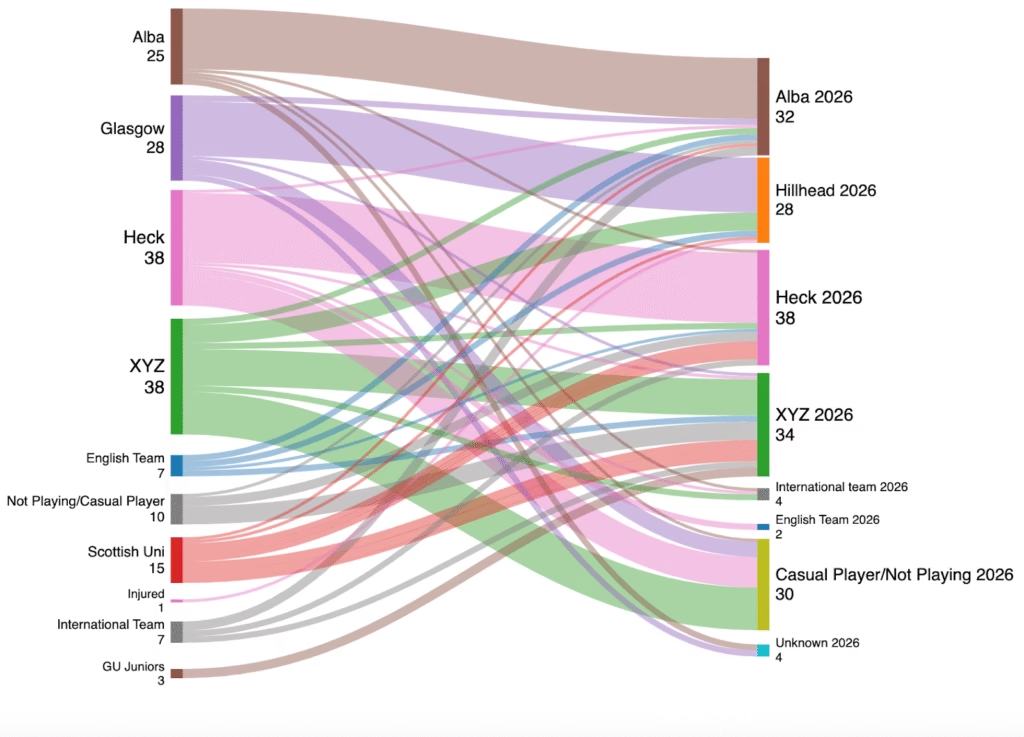
Once again, I combine my love of unnecessary data analytics and ultimate frisbee to bring you a look at how things have shaped up* on the transfer market in Scotland in 2026. For those who don’t know, I take the teamsheets provided on Instagram, cross-reference them with last year’s (as well as some top-secret sources), and give you some totally unbiased the best, the greatest, the ultimate insights, whatever you want to call it, for the season ahead. Here’s how things are looking:
*Note – although technically a player can play for both university and a club team – for this, I have taken the highest of the levels they have played so Casual Player < University < Team
Destination > Scotland
There is often an unwritten assumption that there is a natural progression from Scotland into England or even the rest of Europe. Maybe this has been the case in years gone by, but this is the second year in a row in which Scotland has imported more players from England than we have exported. Only two players have made their way down (both from Heck—and I will add, none moving to London), whereas seven players have made their way up after playing the majority of their previous season with an English club. This seems to be partly made up of players “returning” from their time in England, such as Angus Milliken returning from Ka-Pow in London or Benjamin Tang from Leamington Lemmings, but this is also paired with new players moving to Scotland for the first time such as Lucy Pead (previously of Horizon) and Matt Butler (previously of Thundering Herd).
All of this is to say that I’m happy to completely bust any conspiracy about an England drain on Scotland—and, further, any European drain—with more players coming to Scotland than departing for that department to. My guess is that we just feel the losses of our friends moving away a lot more than we feel the benefit of new players joining our community, and hence why this theory has surfaced—but no more, as we are thriving!
Fresh faces
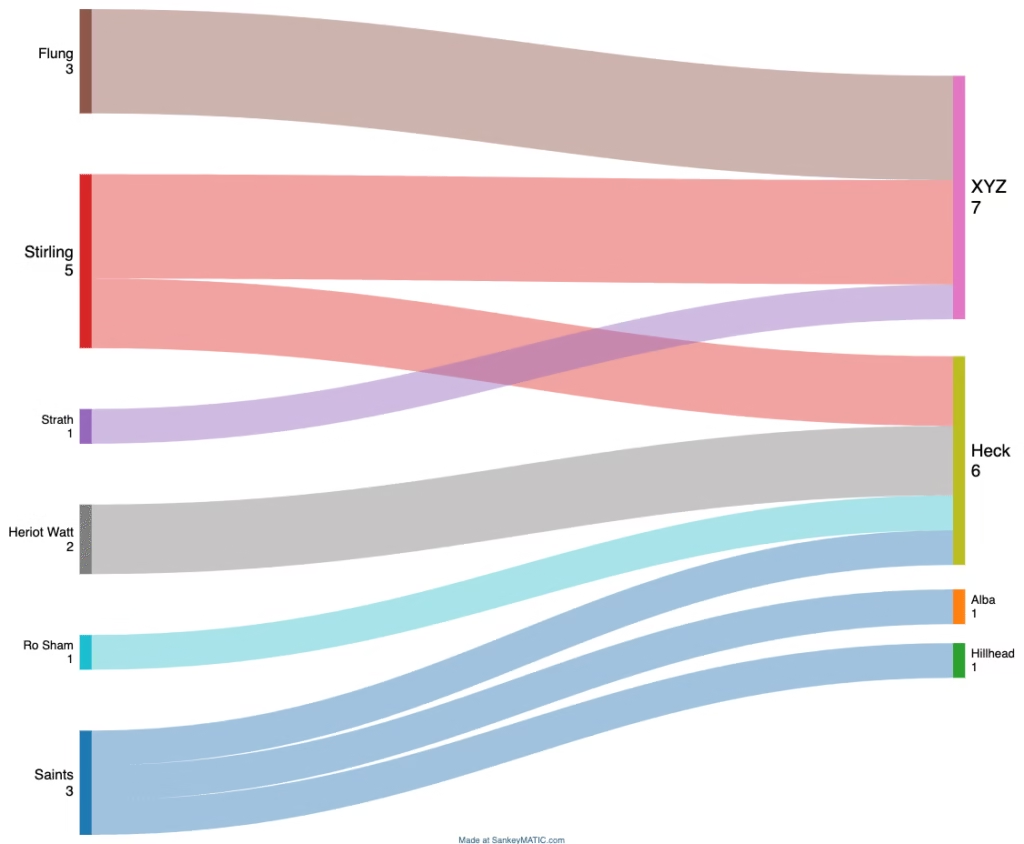
I think this year has been a particularly good one for university recruitment across club teams, with only Aberdeen and Dundee (notably the two furthest teams from the Central Belt) not having a player make their way into a high-level club this season. For the teams that have, there is a big honourable mention for Stirling Blaze, who have the lion’s share of new players coming through, such as Cailin MacLeod for XYZ and Terri Phua for Heck. Traditionally, there would be a clear feed from Glasgow universities into Glasgow-based clubs (Hillhead, XYZ) and Edinburgh universities into Edinburgh-based clubs (Heck), and we definitely still see that in about half of the cases here. However, it’s very interesting to see the impact that Stirling and St Andrews have had on the new recruits coming through. It’s also notable that there has been a shift away from a clear “Young Bucks” strategy from Alba—with only one player, Jerome Gan, debuting for a Scottish club team, and the majority of university players choosing to play for XYZ and Heck, two topics I will get on to.
University Recruits:
An Evolving XYZ
The formation of XYZ four years ago was an interesting one. The team positioned itself at a crossroads of three strategies—being an opportunity for:
- new players to begin their club careers before moving to the big three (or giving up entirely),
- older players to finish their club careers,
- those who want an alternative to the big three, balancing a relatively high level with less international travel commitment.
The impression I got last year was that it was much more focused on the third point, with a large majority of players who played for XYZ in 2024 continuing on in 2025, and only limited movement towards the larger squads. For 2026, with the captaincy of Elsa Geeraedts and Nina Grant, the team has already shifted its focus towards the first of the three points—with yes, some players choosing to leave the club scene, but also many more players coming into the squad fresh compared to last year.
As previously mentioned, there are more university players making their club debuts, such as Matthew Sweeney of Strathclyde and Eloise Wheaton of Farflung, but also the debut of much-anticipated GU juniors such as Susie Ferguson, Zoe Taylor, and Noah Webb—all of whom will also be playing for GBU17 throughout the season and will make excellent additions to the XYZ squad. This has coincided with another addition to the XYZ roster: handsome coach and fantastic journalist Johnny Tofalis, who hopes to build XYZ into a team that can grow and compete with some of the best across the UK. All of this is to say that XYZ is no longer a place for older players to take their boots, ready to hang them up, but a stomping ground for new talent to break through onto the scene.
A Revised Strategy from Alba
Last year saw Alba undergo one of the largest reforms of their squad since their inception, taking on a significantly smaller squad than usual in order to give players more pitch time and avoid watering down the squad with too many non-tournament members. Unfortunately, this strategy led them to struggle with attendance at tournaments and they failed to qualify for Europe for the second consecutive season. This season, they have gone for something of a 180 on that strategy, increasing their squad size by around 40%. This being said, this seem to be inline with what other teams in the UK are doing with the likes of Bristol Open taking 36.
Within this squad, 20 will be returning from last year—with a wide variety of sources making up the remaining 12, including Aaron Hume from England, AJ Strang from XYZ, and most notably the return of Joel Terry, who spent a season with Glasgow/Hillhead. The question remains: with a large number of returning players and a big influx of new talent, will this be enough to return Alba to their previous glory? I’d love to see it, but I am doubtful. It does seem like Alba’s core base is still there, with the likes of Cammy Maccy, Ciaran Delaney, and Alastair McNeill, but the European Open division is a fierce and competitive beast to crack. Breaking into the top 16 has less to do with beating Clapham and Mooncatchers and more to do with teams like Gentle or Ranelagh. Much of this will come down to how the middle and bottom of the Alba roster rise to the challenge, which isn’t completely out of their reach—so I guess from here it’s just a waiting game to see.
Loyalty and non-grass greeners
This year, 62 players (around 40%) are renewing their metaphorical contract with their team. Looking across three seasons, 42 players will be staying for at least their third season, which is around 20%. You can obviously make your own interpretation of this—personally, I think it’s about right, but I can see how people could view it as either very high or very low. And finally, my favourite stat: the “non-grass greeners”—a term I’ve literally just invented to denote the number of people who played for a team in 2024, then a new club in 2025, only to return to their 2024 club. That number is four, with 75% of those going from Alba to another team and back again. Interpret that, as you will.
The Noisy Neighbours Just Got Noisier
Five years ago, when talking about the Scottish scene, each club felt quite isolated in its division. EDI were never going to take down Alba, and Scram and Glasgow were in their own divisions. Now, we find ourselves looking at two elite mixed clubs across two cities—a rivalry that has been building over the last few years, and one that usually goes down to the wire. Game to game, anyone can take it. Over the course of a season, however, Hillhead’s experience usually guarantees them a higher finish at Euros, with Heck coming last at Euros two years in a row—but this year might be a different story.
Although both teams have suffered heavily from players taking a season out, the core of these teams remains relatively unchanged with Captains Aina Zaid and Becca Hardman Carter return for a second year of captaincy at Hillhead, but the captaincy of Tilly Mason and Arjun Kumar may be the spark Heck needs to swing the long game away from Hillhead. Both teams have brought in some fresh legs, with Heck picking up talent, such as Liamh Yard from Heriot-Watt, and Hillhead utilising XYZ to mature their talent pool beforehand with the likes of Taylor Sweden and Lauren Wright.
Where I see the largest difference year on year is the top of each squad – the loss of Joel Terry for Hillhead might be a pretty monumental loss, and pair this with the signing of Alba royalty Cammy Agnew, and Heck’s top line could be one to cause some upsets on the european scene.
Where does this leave us?
A lot can change in a year, and often it can feel like for Scottish teams at least, the squads go through pretty monumental transformations almost every year. As I’ve said before, “One could easily make an arguments for teams looking stronger or weaker. What a team loses in star power, chemistry and experience it gains in longevity, enthusiasm and untapped potential, setting the stage for a season full of surprises and breakout performances.” and I think these words will be as true now as they were last year.
I think looking the lack of Worlds qualification for Scotland last year can be an easy way to assume that things have dipped at the highest level but the way I’m looking at it is that we have an extra year until the next World Championships and Scotland has great infrastructure already to bring in young players for this round:
- As I’ve shown and unlike a lot of England, the sport exists pre-university – and we have already yielded fantastic players from this
- As I’ve shown, most of our universities have ability to train players to be good enough to want to play for elite club teams with many of them having coaching staff or alumni to guest lead sessions
- All of our club teams have coaches/non-playing members (hiya)
- As I’ve shown, players aren’t disconnected once they stop playing at university and can continue to grow at Hillhead, Sneeekys or DDD to later look at joining the scene
Pair all this with the complete debunking of any England bleed- I firmly believe that Scotland positions itself in a great position in the future and this season being a great opportunity to develop without the strain Worlds and without that as a focus for the year, you never know, the English teams may take their eye of the domestic and European ball. Either way, I’m excited for the season ahead.